Random Walk & Diffusion
Can deterministic macroscopic behavior — diffusion — emerge from pure randomness, and does the macroscopic law remember the microscopic step?
Thousands of walkers from the origin. Switch the step rule between lattice, Gaussian, and Pearson — the cloud spreads the same way and the measured ⟨r²⟩/4t lands on the same D. Turn on drift to see advection-diffusion.
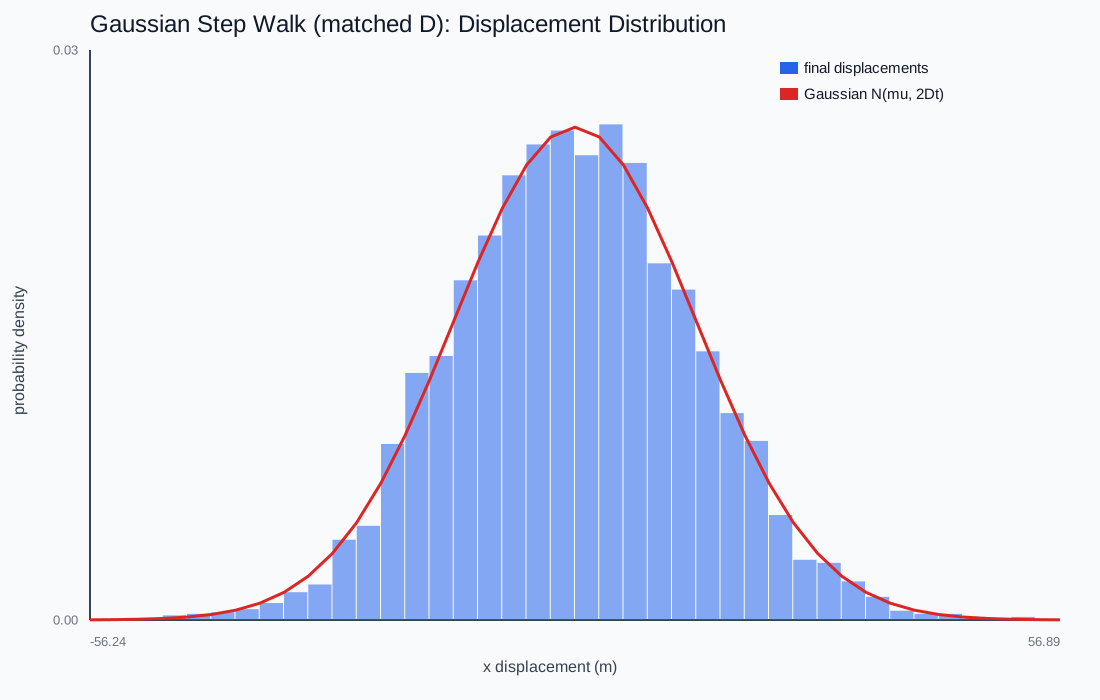
Three rules, one law
Lattice steps, Gaussian increments, and fixed-length Pearson jumps are very different microscopically. Yet with matched parameters they all reach the same diffusion coefficient and the same \langle r^2\rangle \propto t growth. The microscopic rule sets only the number D; the form of the law is universal — the random-walk face of the central limit theorem.
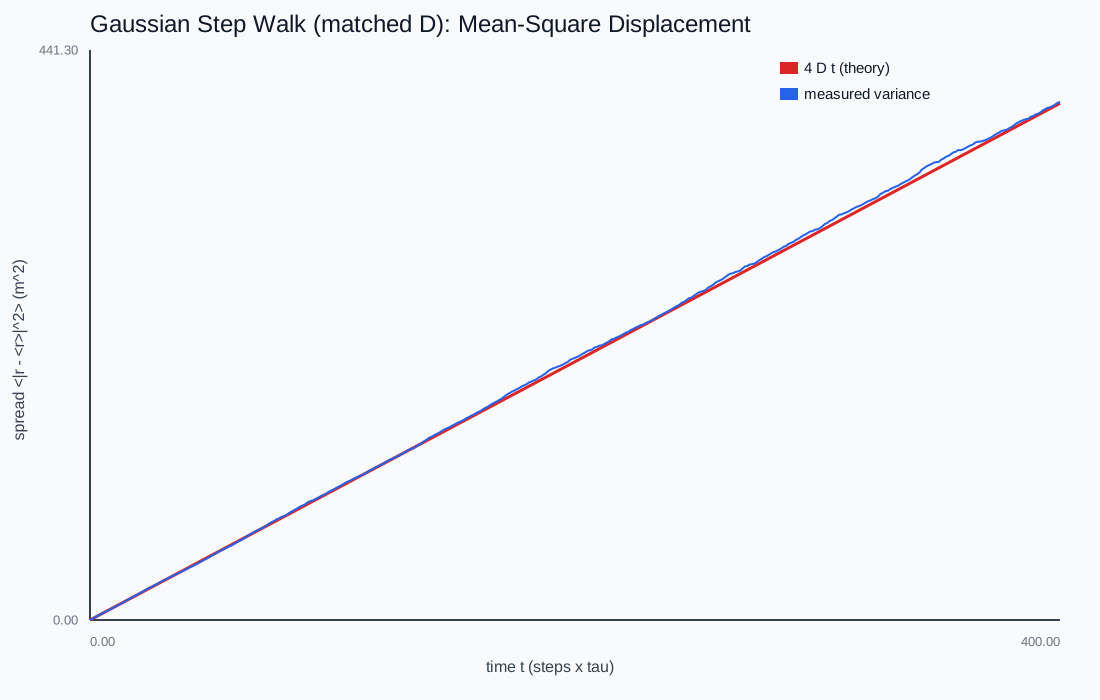
Linear, not ballistic
The signature of diffusion is that the spread grows linearly in time: \langle |r-\langle r\rangle|^2\rangle = 4Dt in 2D, with D = a^2/4\tau for fixed-length steps. Not the t^2 of a moving particle, not saturating — linear. The lab measures D = \text{variance}/4t live and lands it on the formula.
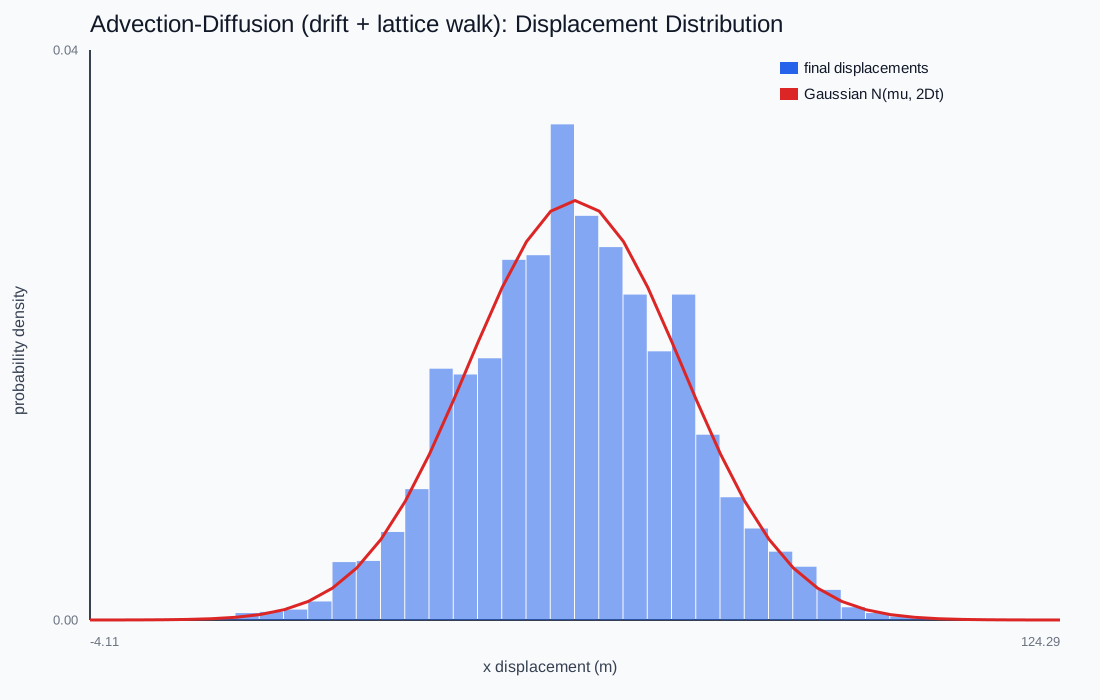
Brownian motion's skeleton
This is the bridge from the gas lab to real Brownian motion: a heavy particle jostled by a gas takes effectively random steps, with D = k_B T/\gamma by the Einstein relation. Strip away the forces, keep the randomness, and diffusion is what remains.
This chapter is drawn from the physics-lab study notes and renders. The longer write-ups and project essays live on the blog.