The Mass-Spring Chain
How does a chain of point masses turn into a medium that carries waves, and what controls their speed, modes, and reflections?
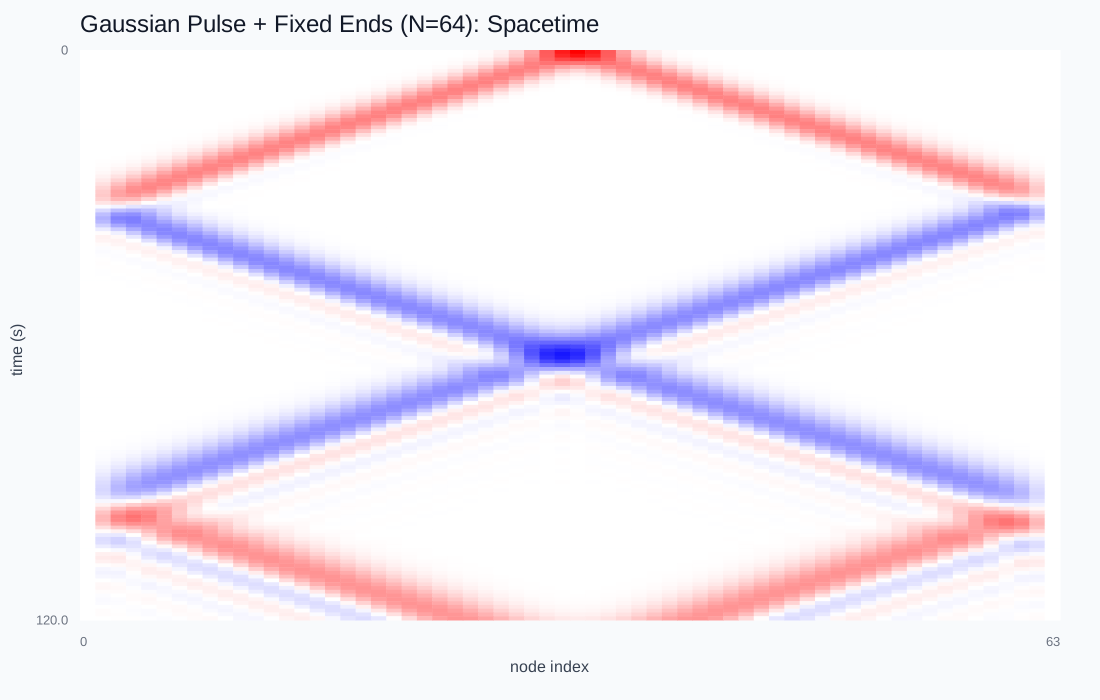
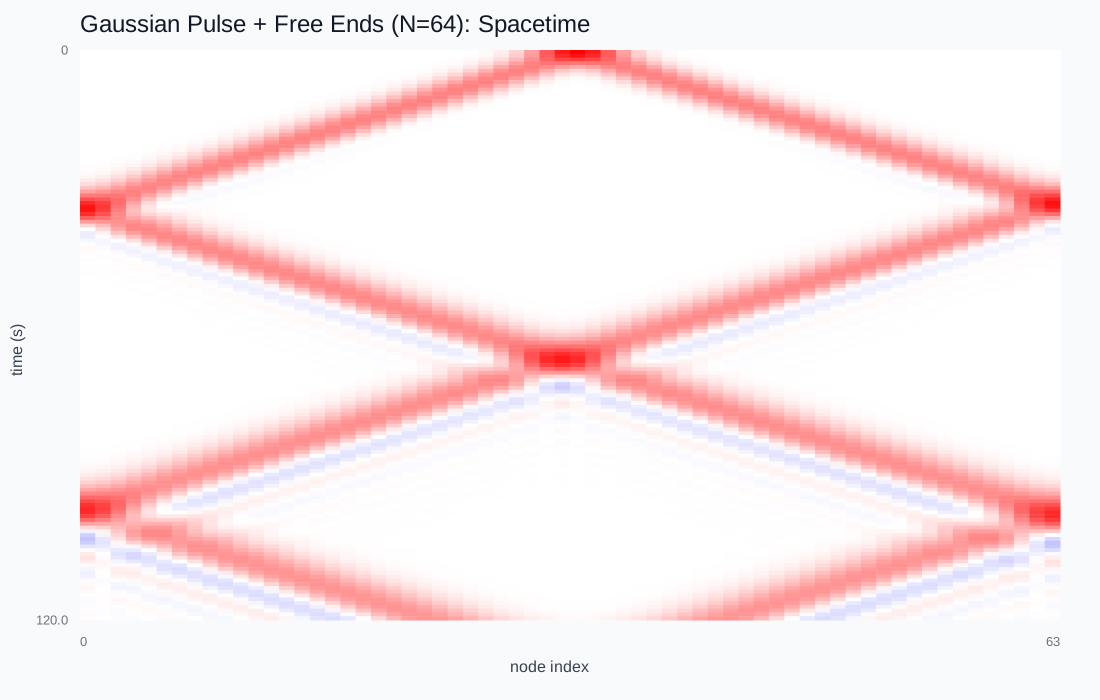
Send a Gaussian pulse down the chain, or excite a pure normal mode. Toggle the ends between fixed (pulses reflect inverted) and free (no inversion), and add damping to watch the wave decay.
A discrete wave equation
Each interior mass feels m\,\ddot u_n = k(u_{n+1} - 2u_n + u_{n-1}) - \gamma\,\dot u_n. That second difference is a discrete second spatial derivative, so in the long-wavelength limit the chain is exactly the 1D wave equation u_{tt} = c^2 u_{xx} with speed c = a\sqrt{k/m}: stiffer springs and lighter masses make faster waves.
Boundaries are physics
Fixed ends reflect pulses inverted; free ends reflect them upright; periodic ends wrap the chain into a ring where waves travel forever; a driven end is an oscillating source. Running the fixed and free pulses side by side makes the inversion unmistakable.
Lattice dispersion is real
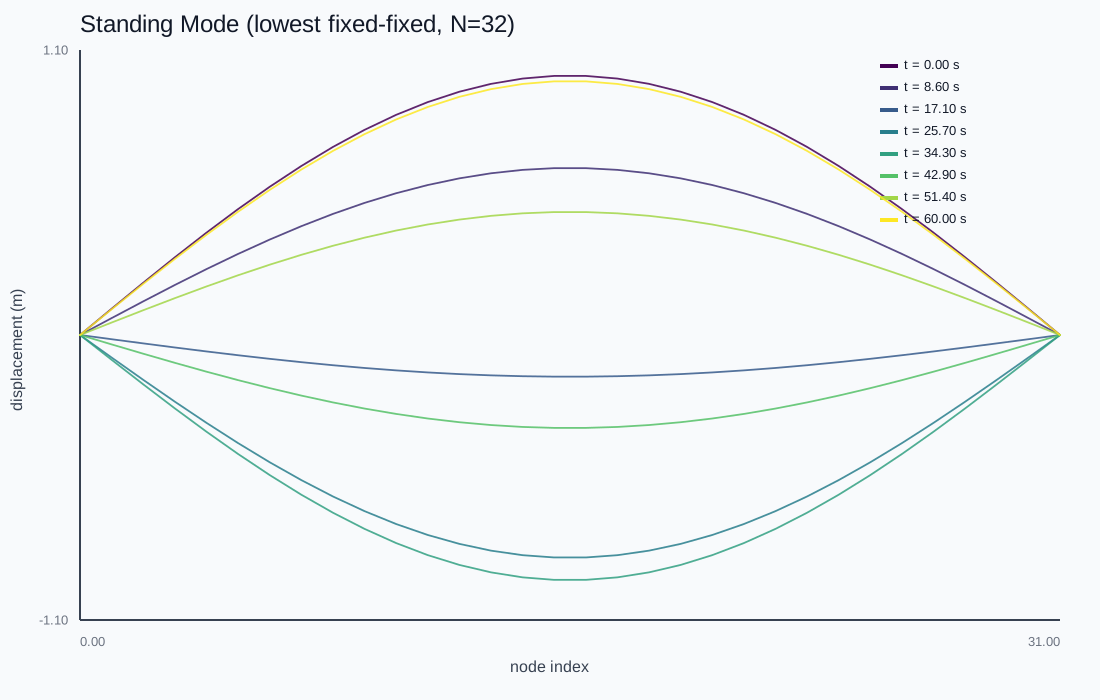
A fixed-fixed chain of N nodes has N-2 standing modes with \omega_j = 2\sqrt{k/m}\,\sin\!\big(\pi j/2(N-1)\big). For long wavelengths this is the familiar evenly-spaced harmonic series; for short wavelengths the sine saturates and modes travel slower than the wave equation predicts. That gap is numerical dispersion — and it is a genuine, physical feature of any discrete medium, not a bug.
This chapter is drawn from the physics-lab study notes and renders. The longer write-ups and project essays live on the blog.