Hard-Disk Collisions
What is conserved through a collision, what is not, and how does the coefficient of restitution interpolate between elastic and perfectly inelastic?
Disks colliding in a box. Sweep the coefficient of restitution from 1 (elastic) to 0 (sticky) and watch the kinetic-energy readout fall while momentum is conserved. Toggle gravity to settle them into a jostling layer.
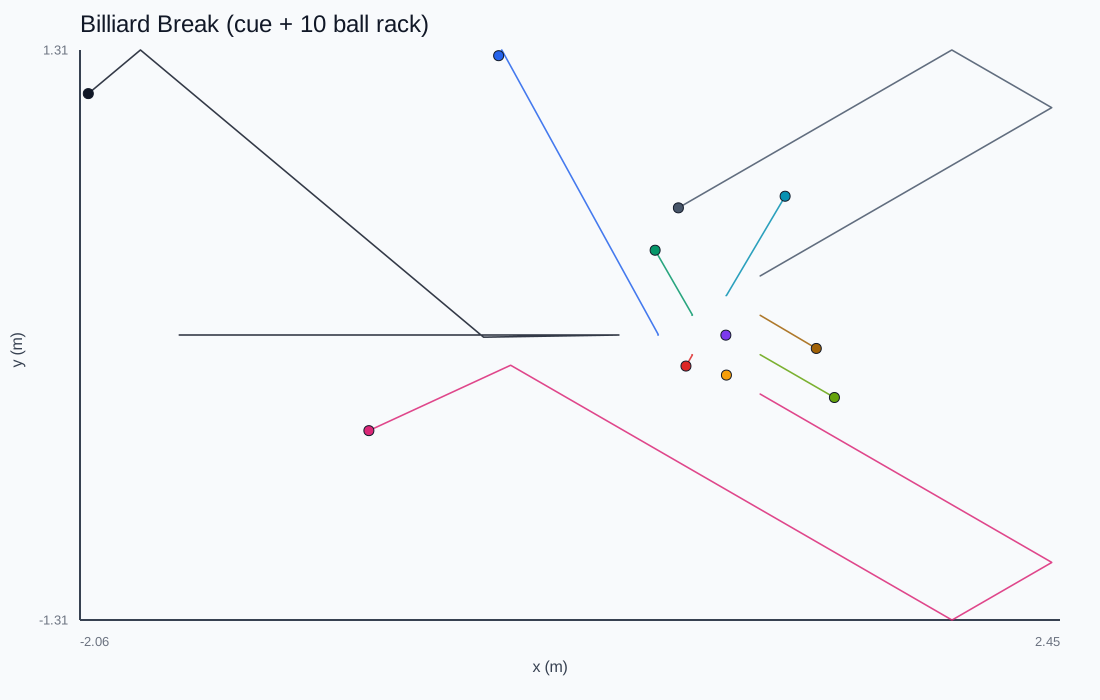
The impulse
On contact, an impulse acts along the line of centers: j = -\dfrac{(1+e)\,(v_{\text{rel}}\cdot\hat n)}{1/m_i + 1/m_j}. The coefficient of restitution e runs from 1 (fully elastic) to 0 (the disks move together afterward). The impulse fires only when the disks are approaching, so resting contacts produce no spurious kicks.
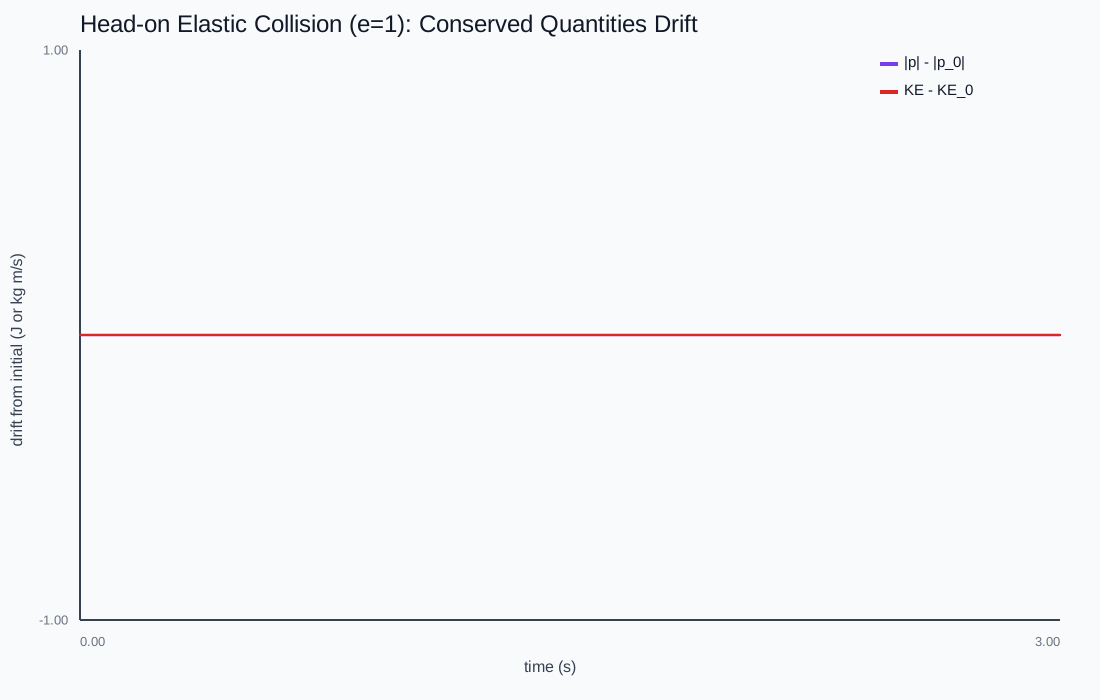
Momentum always, energy sometimes
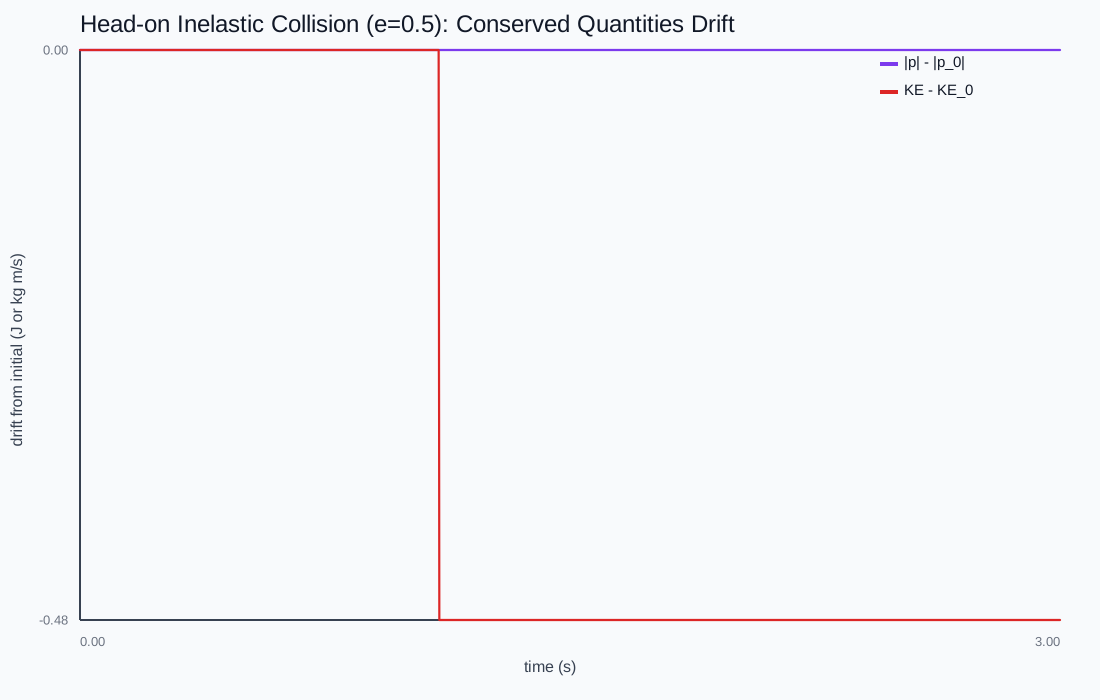
Because the impulse is equal and opposite, momentum is conserved for any e — even a perfectly inelastic collision conserves momentum. Energy is what distinguishes the regimes: a collision removes exactly \tfrac12 (1-e^2)\,\mu\,(v_{\text{rel}}\cdot\hat n)^2, so e=1 removes nothing and e=0 removes all of the normal relative kinetic energy.
Two clean theorems
Equal-mass head-on elastic collisions swap velocities exactly. Equal-mass glancing elastic collisions send the two outgoing vectors off at exactly 90° — their dot product crossing zero is the thing to verify. Both fall straight out of the impulse rule.
This chapter is drawn from the physics-lab study notes and renders. The longer write-ups and project essays live on the blog.