The Lorentz Force
The magnetic force acts perpendicular to velocity and does no work. What motion does v×B produce, and why does it demand a special integrator?
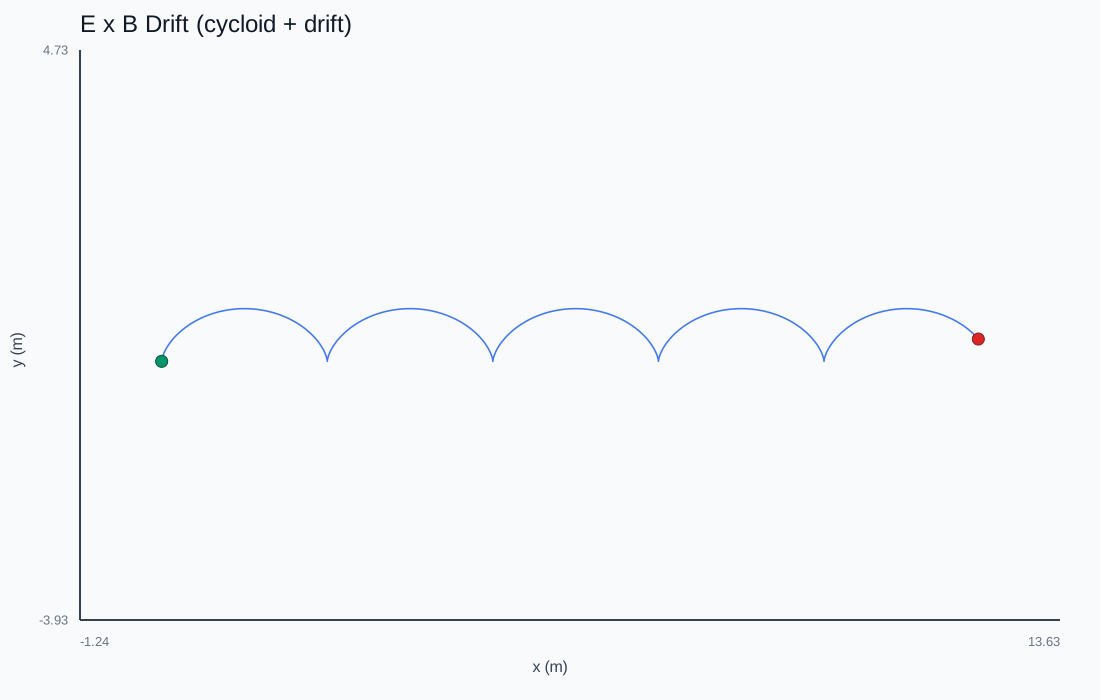
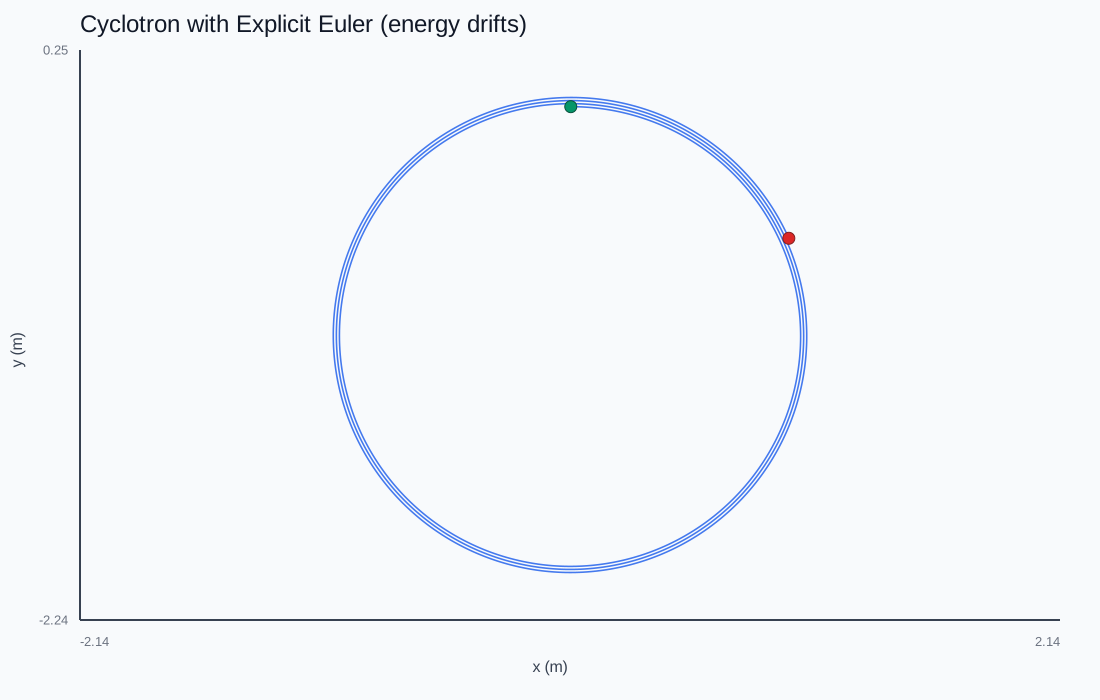
A charged particle in crossed E and B fields, pushed by the Boris algorithm. Add an E field to see the cycloidal E×B drift; flip the charge; or switch to explicit Euler and watch the orbit spiral out as energy leaks.
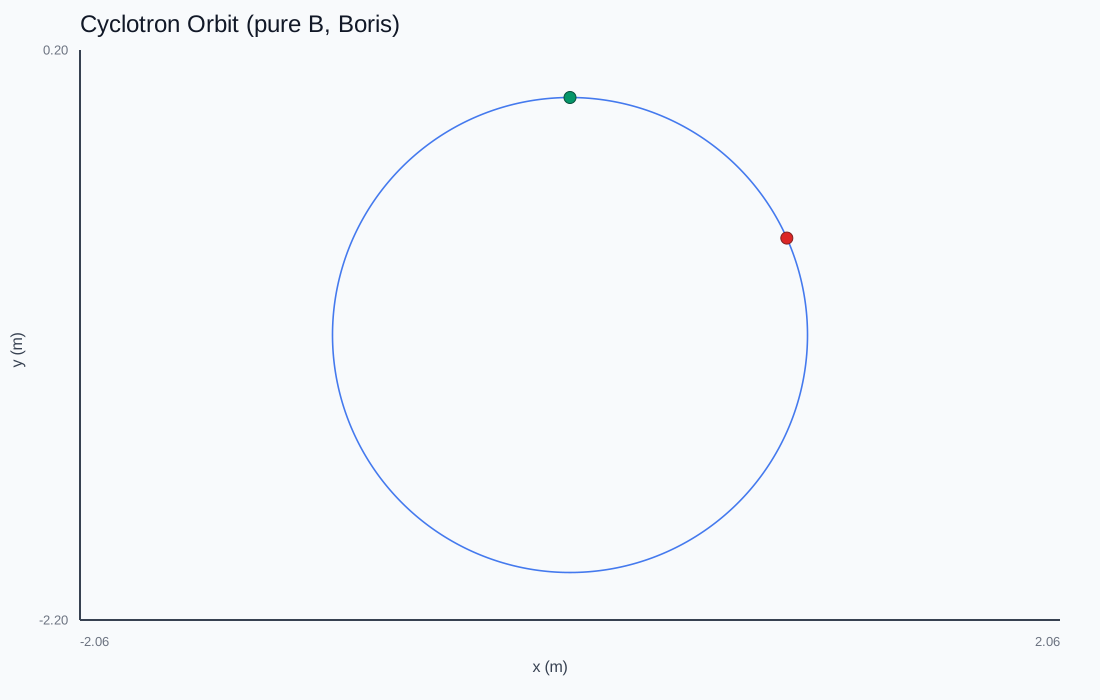
A force that does no work
m\,\frac{dv}{dt} = q(E + v\times B). The magnetic term is always perpendicular to v, so it turns the velocity without changing its magnitude. In a pure B field, speed — and kinetic energy — is an exact invariant of the continuous motion, and the orbit is a circle of radius r = m v_\perp/|q|B at frequency \omega_c = |q|B/m.
The Boris pusher
A naive integrator destroys that invariant: explicit Euler rotates v and lengthens it every step, so the orbit spirals out. The Boris pusher splits each step into a half electric kick, an exact magnetic rotation, and a second half kick. The rotation preserves |v| to machine precision — the magnetic analogue of choosing velocity-Verlet for Hamiltonian mechanics.
The E×B drift
Add a steady E perpendicular to B and the particle does not accelerate along E. Instead its gyration develops a steady drift (E\times B)/|B|^2, perpendicular to both fields, at a speed independent of charge or mass. Flip the charge and the drift direction is unchanged — both the gyration sense and v×B flip together.
This chapter is drawn from the physics-lab study notes and renders. The longer write-ups and project essays live on the blog.