From ~0.15 to ~0.60 Reward: Fast RL Gains on Low-Resource Translation with Small Tweaks
Low-resource language translation is one of the clearest places where modern LLMs still underperform. For many communities, that gap is not academic - it affects access to information, education, and public services.
In this project, we built a low-resource translation environment with Prime Intellect Verifiers and trained on Hosted Training. The interesting part: we got a large reward jump with a handful of practical changes, not a huge architecture overhaul.
Why this problem matters
Most model pretraining data is heavily skewed toward high-resource languages. That creates a quality cliff for low-resource languages like Yoruba, Swahili, and Welsh, especially for faithful translation under strict format constraints.
We wanted a setup that is measurable, reproducible, and easy to iterate in RL.
Environment setup (Verifiers + Hosted Training)
We implemented a custom Verifiers environment: low-resource-translation.
Environment link: Prime Intellect Environment Dashboard
Environment reward rubric (dense + practical):
rubric = vf.Rubric(
    funcs=[chrf_score, threshold_bonus, format_length_reward],
    weights=[0.85, 0.15, 0.05],
)
Dataset
- FLORES-200 sentence files
- English-pivoted translation directions:
- from_english (English -> low-resource)
- to_english (low-resource -> English)
Why this implementation detail mattered
The Hugging Face facebook/flores loader script is not compatible with datasets==4.x script loading behavior. So we moved to a script-free loader path: direct FLORES sentence files + caching. That made training and eval stable in our runtime.
Reward design (current)
We designed reward signals with three simple pieces:
- chrf_score: dense continuous translation-quality signal.
- threshold_bonus: extra reward when output crosses a target quality bar.
- format_length_reward: small auxiliary term to discourage rambling and formatting drift.
We also keep metrics like length_ratio, exact_match, and num_turns for diagnosis.
Model and training config (example)
model = "Qwen/Qwen3-30B-A3B-Instruct-2507"
max_steps = 200
batch_size = 64
rollouts_per_example = 2
# max_async_level = 1
# learning_rate = 5e-5
# lora_alpha = 16
# env_file = ["secrets.env"]
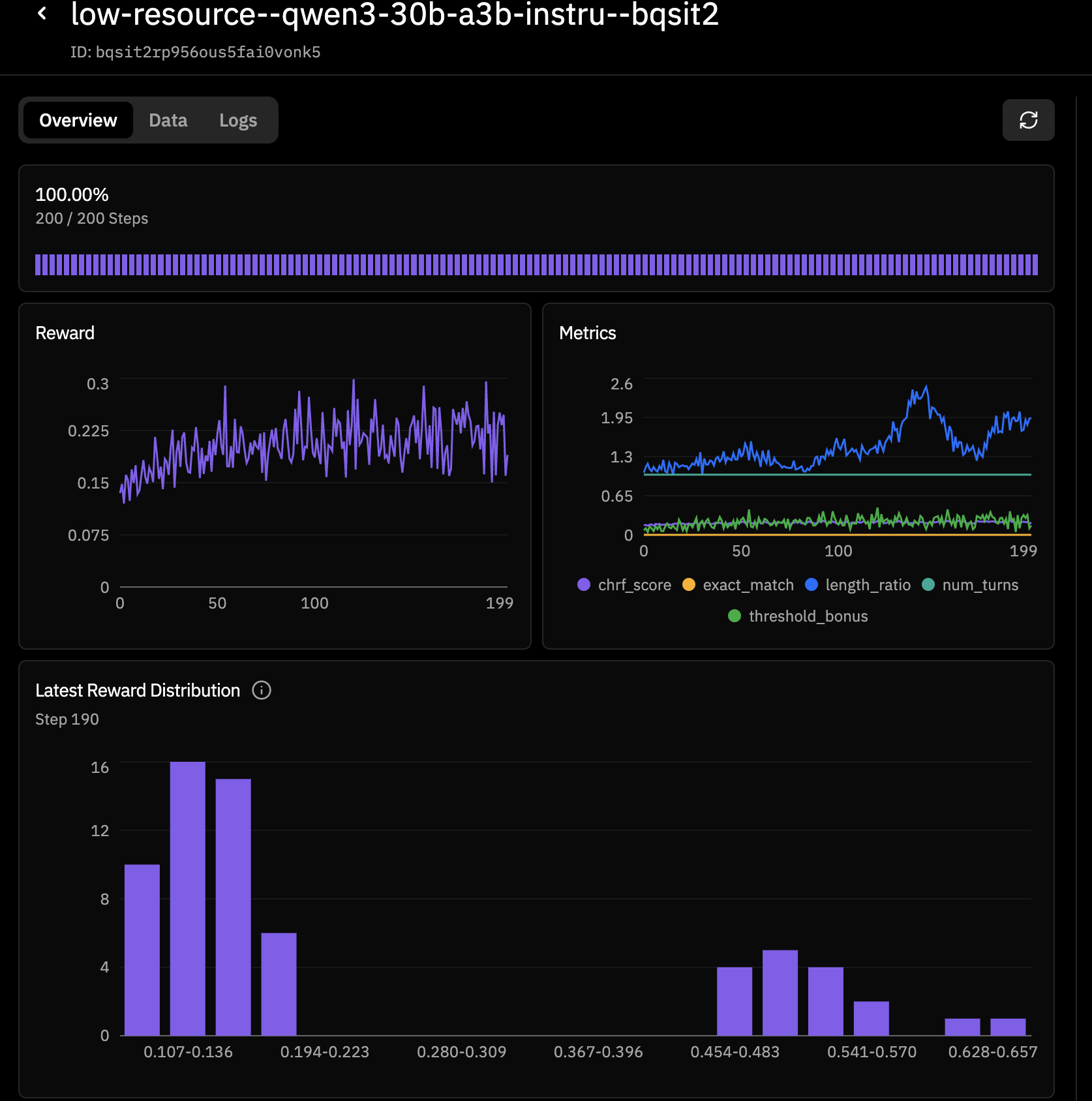
Run 1 (baseline): reward moved ~0.15 -> ~0.30
In the first run, reward started near 0.15 and trended up to roughly 0.30 by the end of training. That was a good "it learns" signal, but still noisy, with broad reward spread and many low-quality outputs.
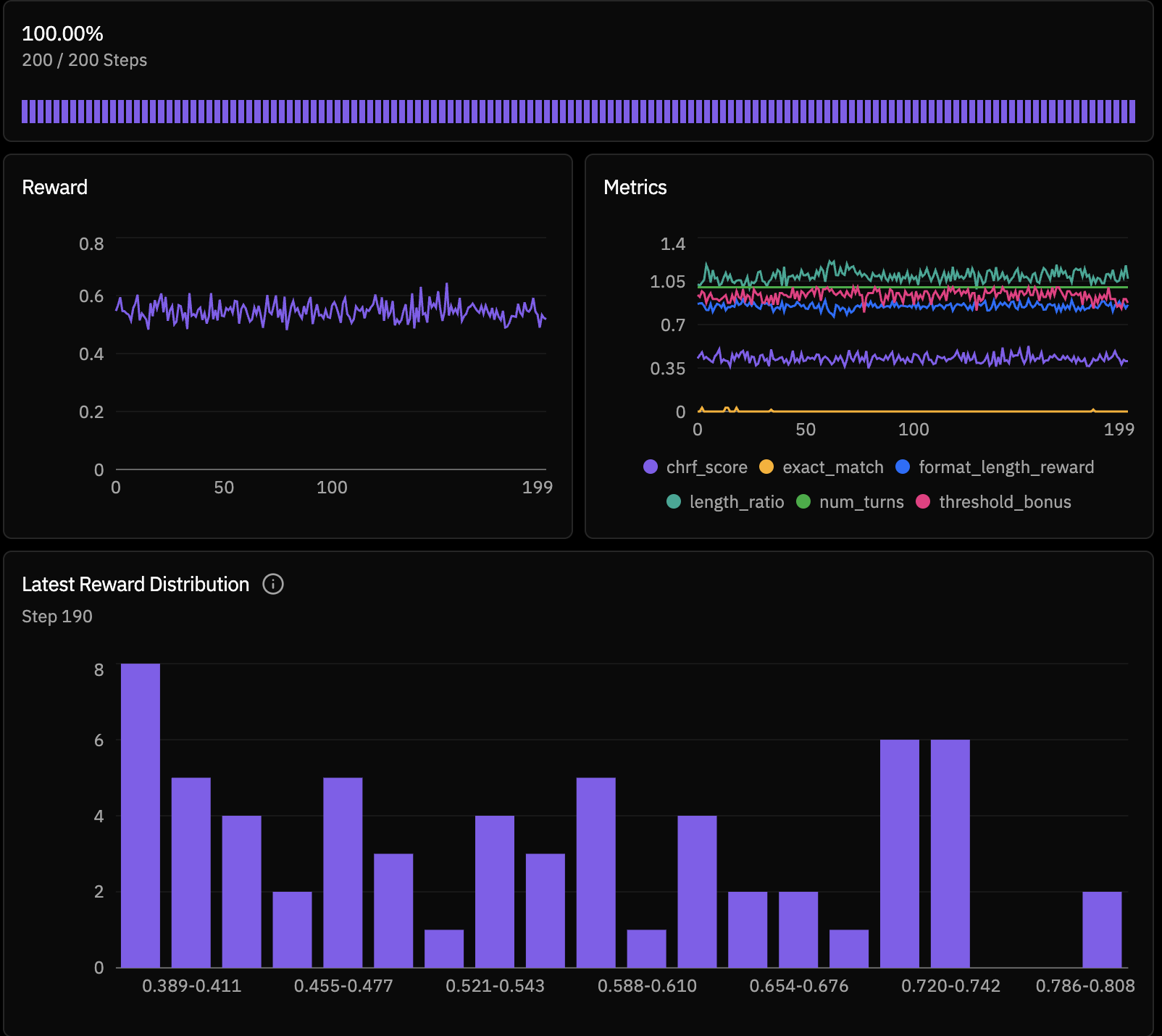
Run 2 (after small tweaks): reward stabilized around ~0.59-0.60
After targeted changes, the second run shifted reward upward and much more consistently, with values clustering around 0.59-0.60 (and occasional higher bins).
The tweaks that moved reward quickly
- Start with easier curriculum first: train direction="to_english" first (Yoruba/Swahili), then add from_english. This gives a cleaner supervision signal early and improves stability.
- Make reward denser: shifted from sparse-ish weighting to a more continuous emphasis: 0.7/0.3 -> 0.85/0.15 (chrf_score / threshold_bonus), plus a small format/length auxiliary reward.
- Lower threshold initially: chrf_threshold from 0.25 down to 0.18-0.22 for early learning. Later, we can raise it once the model stabilizes.
- Stabilize decoding: low temperature (~0.2) and tighter max tokens (128-192). This reduced noisy outputs and improved reward consistency.
- Reward output hygiene: the format/length reward helped reduce rambling and keep outputs closer to clean translation form.
What we learned
- Small reward-shaping and curriculum changes can dominate early RL gains.
- Direction matters: to_english is often an easier starting curriculum.
- Output discipline matters: decoding + format reward can materially improve training signal quality.
- Infrastructure details matter too: data-loading compatibility can be the hidden blocker before model quality.